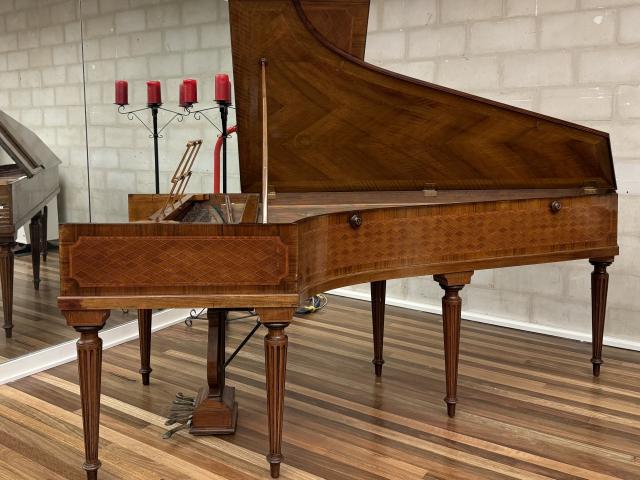
The Austrian musical entrepreneur Ignaz Josef Pleyel (1757–1831) settled in Paris and founded a piano-making enterprise which would last until 1961.
Known from 1887 as Pleyel, Wolff, Lyon et Cie, the company became integral in the rediscovery of the harpsichord in the early twentieth century. This was especially because of its close association with the Polish-French musician Wanda Landowska (1879–1959).
Built in piano factories and using piano technology, harpsichords like this one from the early years of the revival were a far cry from the historic instruments they were trying to emulate. With its heavy iron frame, steel strings, unenclosed body, and complicated action, the Pleyel bears much more in common with the modern piano than what we know now as the true harpsichord. A special feature of Pleyel harpsichords were its fine tuners, which could incrementally rock each tuning pin backwards or forwards.
Nevertheless, these modern harpsichords managed to attract interest, and spawned important compositions including Manuel de Falla’s Concerto and Francis Poulenc’s Concert champêtre. Both these works were written for Wanda Landowska in the 1920s.
The Pleyel’s two 61-note FF–f´´´ keyboards have ivory naturals and ebony accidentals. There are three choirs of strings with 2 x 8´ and 4´. An additional lute register plucks the front 8´ (upper keyboard) strings close to the nut, producing a thinner, nasal tone. A buff stop also operates on the front 8´ strings. All registers and the coupler are operated by pedals suspended in a lyre. The instrument rests on Louis XVI-style turned and fluted legs.
This harpsichord is on long-term loan to the ANU Keyboard Institute courtesy of a private musician.
Provenance
HARPSICHORD
Pleyel (Paris, France)
1907–08
Serial no.139064